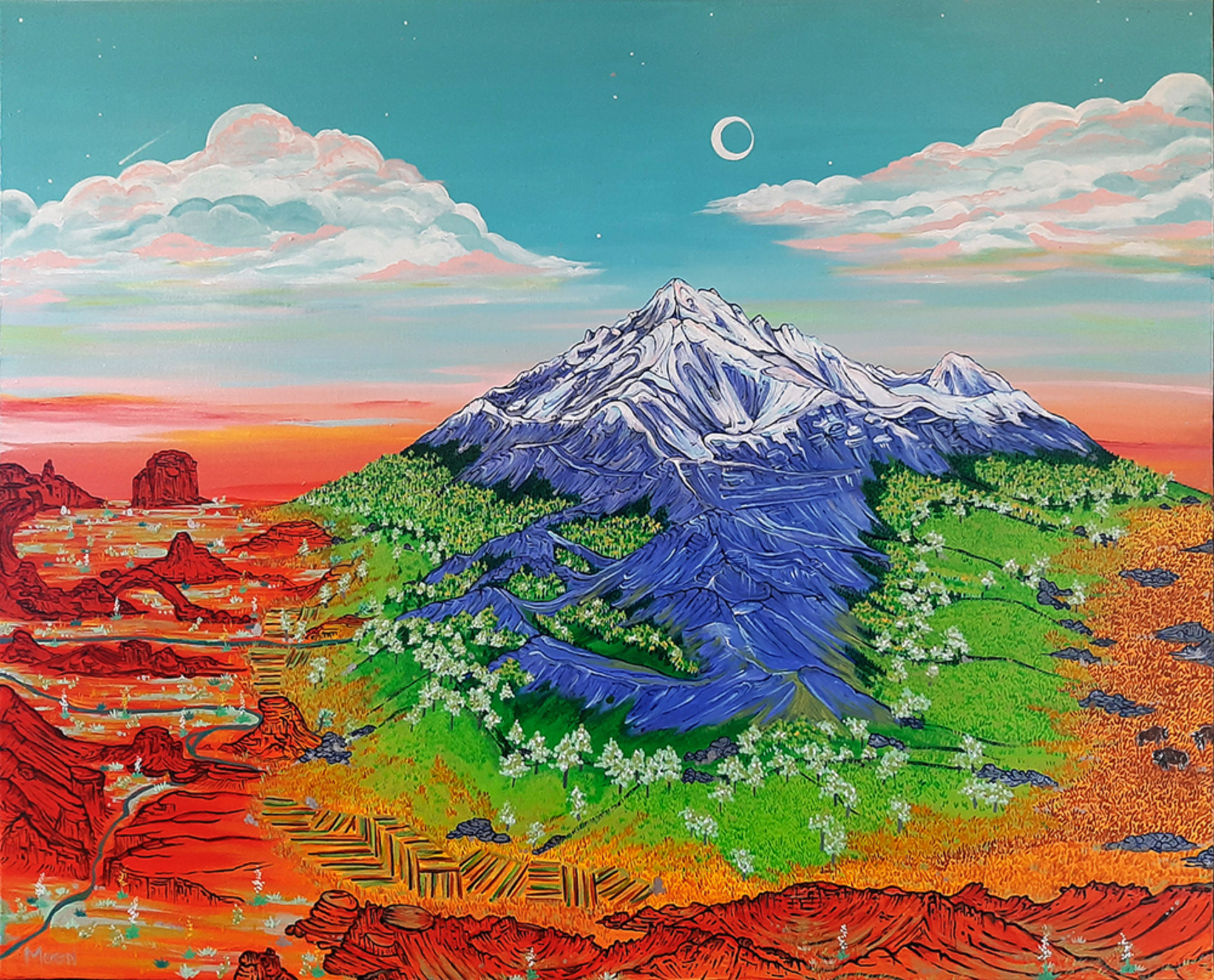

There is a prayer, of sorts, of gratitude I try to give as often as I can.
Whenever I can remember, I like to express–and feel deeply–gratitude for simple matters that are, in fact, profound: I am healthy, safe, and loved.
When I was a child I had one of those awakenings of consciousness that are so wonderfully common in childhood, and often sought after as an adult through intense effort. I was experiencing a headache, probably due to dehydration, as I never drank enough water as a child. In Colorado, where I grew up, if you do not have a constant supply of water, you will get dehydrated. There quite simply is not enough moisture in that environment to go around. That’s why there’s the stereotype of Coloradans traveling everywhere with their Nalgenes. It’s an accurate stereotype. Coloradans carry their water bottles everywhere because they do not want to turn into sandpaper. Anyone who has lived in Colorado for any extended period of time ends up building this habit, and I still feel quite nervous if I’m out and about and don’t have my comfort Nalgene with me, even though I now live somewhere quite cool and humid.
As a child I had not yet fully wizened to the need to be hydrated. Drinking water was a chore, and one done begrudgingly. So a headache was not uncommon. On this particular day, as I was carrying around this particular acute, persistent, present pain of a headache, I remember looking around at friends who were playing–loudly, freely, roughly, with their brains demanding much less of them than mine was of me. As I looked around I had the clear thought: Those kids don’t know how good they’ve got it. They should be happy that they are not in pain. And then, I had the rather wonderfully self-aware thought: How often, when I’m not experiencing a headache, do I myself really feel grateful for it? A headache is something that is easy to not think about when you aren’t currently experiencing one. Any ache is like that, I suppose, if it is conditional. I set a resolution then: that I would notice and feel grateful for the times when I was not experiencing a headache.
Thus, the first component of the lifelong prayer was born: I became grateful to be healthy.
This resolution further edified as I began to become more aware of the impact that physical ability has on the lives of others. There was a lovely girl at my grade school who was in a wheelchair from an early age due to an ATV accident. There was another woman early in my life who was in a wheelchair–she dated one of my dad’s best friends. She was a painter, and would take me with her to paint rivers and landscapes. I recently remembered her again, and was surprised I had forgotten her. I have no doubt that she was an early influence for me as an artist–it was wonderful to have someone who validated and nurtured that creative curiosity as a small child (notably someone who wasn’t a parent, which adds a certain extra gravitas to the encouragement). Coincidentally, both of these people were named Amanda.
I’m sure there were many other people I had encountered as a child who had physical disabilities, but I remember the two Amandas the most. I think part of the reason I remember them so well (apart from them both being named Amanda, which does make it easier) was that they were both so kind, full of fervor, and, as far as I could tell as a young child, still so capable to live their lives very fully. The fact that they were in chairs added to their personalities, but I did not consider it to be their personalities.
I also remember feeling grateful that I could live a life where I did not have to worry about limitations in my body in the same way that I was sure they did. I never had to worry about there being a ramp to get in or out of a building. I never had to worry about special accommodations to engage in the activities I loved. I became more aware of my functioning legs, and this absence of worry in my life. There was an increased awareness that I seldom acknowledged my healthy legs, and how they just worked without me needing anything more from them.
As I grew, so did the increasing awareness of the fragility of health in life. With getting older it is inevitable that throughout life one encounters many people who are well and then they are not–and they may not ever be well in the same way again. I saw people become sick and die, or become injured and have it completely transform their lives. I further became resolute to appreciate the health, strength and youth of my body–and the functionality of all of its components.
Of course it is quite natural and right that we don’t consistently notice all that we aren’t. It would be incapacitating to live in a constant state of what is not. As many Zen teachers would encourage, it is appropriate to practice constantly abiding in what is. However, most Zen teachers would probably continue on to attest that in noticing what is we are also noticing what is not (and vice versa). As with all things, a manageable and appropriate balance (or, middle way, if you will) needs to be reached.
Living in a monastic setting with extensive time for meditation was a lovely environment to play with this balance of attention, as well as to deepen my appreciation for my body. As is common, my mental state was rife with competing opposites. For while, as a child, I did set the intention to be grateful for my body–I eventually went through adolescence and found a whole host of reasons why my body was not enough. There are extensive explorations elsewhere that I’m sure any reader has encountered about the ubiquity of modern teen girls being actively encouraged to hate their bodies. This was a phenomenon I was not exempt from. There were many reasons, starting in puberty and carrying forward, that I was unhappy with my body. It was a deep unhappiness, as it is with many. It was an unhappiness that is subversive and pervasive.
One of the many things I worked on while sitting hundreds of hours on the meditation cushion during my three years living in monasteries was trying to meet that developed hatred with love. I talked in my last blog post about the insights and practices I undertook during that time to transform the hatred that my mind felt towards itself. To a large extent, I was able to transform my relationship with my anxiety and depression through practicing self love. I also worked on accepting the rest of my body through radical self love too.
One of my practices that I developed then and still carry with me today is giving gratitude to my organs. The organs are, of course, a vital component of what keeps us alive and healthy, and are often an unsung hero. Now this is potentially too much information, but I find it charming and pertinent, and so I will talk about it nonetheless: one of the arenas in which I practiced this self love most was in the bathroom. If I just had a healthy bowel movement (which I often did during those days–I ate large bowls of salad and fresh farm greens daily), I would always pat my core and give a little “thanks” to everyone in there that made it happen. I would thank my stomach, my small intestine, and my colon. I would thank them all for doing such a good job for absorbing nutrition and removing waste. What a wonderful thing! It’s still something I try to do, although, admittedly, with less regularity. It feels good to give those parts of me that appreciation.
I was very fortunate to have had little body pain while meditating (another thing to be grateful for, at the time and now). A lot of my fellow monks experienced knee pain, sciatica, lower back pain, and the like while they were meditating. For those who have not attempted to do so and may not know, I’ll let you know that sitting in perfect posture, unmoving, sometimes for hours (or, at times, days) on end, is not an easy task on the body. It requires constant love and attention while doing so. If you have a pain while holding the posture for an extended period–with absolutely no mental distractions–that pain is felt.
The only pain I regularly experienced was that of a wiley rib. Due to my work at the time as a gardener (most of which was spent bent over weeding) and my blossoming love of creating art (most of which I did on the floor), my posture while not sitting was almost always spent hunched completely over. This encouraged one particular rib to consistently slide out of place, agitating the muscles around it quite a lot as it did so. I did see a chiropractor quite regularly to help me get that rib back into place. However, unless you combine chiropractic work with a lot of other work to mediate the situation (like not consistently swinging between living either hunched over or ramrod straight), then the bones just end up sliding on back to what they were doing before the adjustment.
I would sit on my cushion and my muscles around the unruly rib would be upset with me and that displaced rib. They’d be seizing, clenching, spasming. I found that something that helped calm those muscles, quite actually, while meditating was sending them some very concentrated love. I actually ended up picturing the convulsing muscles as a very large floppy-eared rabbit (who knows why). I would picture myself holding this large rabbit in my lap, and as my muscles would contort, so would my mental rabbit. I would then hold, stroke, pet, and soothe the rabbit, just as I would a real rabbit who was experiencing pain. I would do my best to tend to it. I sent all of that energy to the muscles, and they would actually relax. They would feel tended to just as a scared or hurt animal would. Sometimes all it takes to heal is to be known.
I am grateful I have lived the majority of my life with some amount of awareness and practice towards appreciating the health of my body. It is not always easy for an anxious mind to do so, so I’m glad I have some tools and habits in place to counteract the inevitable bouts of hypochondria that arises from time to time. As I’m aging, I’m confident that practicing gratitude for my health will only become more and more of an acute need. In my life now, there have been many intense health-related tragedies for those I care about. My husband’s family is undergoing a lot of trials around health right now, ones that are huge and scary: cancers, huge falls with broken bones, even a recent death of someone dear due to illness. The reality of the fragility of health is something that helps inspire the triadic nature of my prayer. It is worthwhile, when well (even relatively so), to give gratitude for that wellness. It is also wonderful that there are two other components to the prayer that are just as potent as the gratitude for health that can offer strength and reassurance as well.
As with all of the good trinities, it is undoubtedly wonderful to have all three in tandem. To have health, safety, and love is the paramount of existence. It is a feast to have all three. There are so many people in the world who only have two, one, or even none. So to know that I have all three in abundance is a gift beyond measure. There is also comfort in knowing that if and when my health declines, I have established practices to find just as much fulfillment in the other two aspects of the gratitude prayer.
As for feeling grateful to be safe–well, it is no small matter to be safe. This is the most recent addition to the prayer. This is, I believe, the easiest one to forget about day to day. It is a true privilege to live a life that is mostly safe.
In my early twenties I–along with many other white people in contemporary America–began to wake up to my white privilege. It was an unnerving experience, to say the least. It was realizing that we are already living in a sort of dystopia–only I hadn’t noticed because I am in the privileged class. We are living in the Hunger Games and I am a citizen of the Capitol. When reading dystopian novels growing up, I was always interested in the psychology of the privileged elite in the stories–how did they not grasp the reality of all of the suffering and sacrifice that went into making their lives so comfortable? To then realize that I had, myself, been subject to that same ignorance was upsetting. It made me angry, because I came to understand that I had been conditioned into that ignorance entirely without my willing consent. It was the unsettling realization that the authors of those books wrote those dystopian stories not as a warning of what could come, but as a reflection of what is occurring now.
I would hear rap songs and would think almost nothing of the repeated, insistent, angry lyrics crying out about the brutality of living in a black body in America. How could that expressed pain be consistently filtered out in such a way that I never really noticed it? Around the time of the awakening around my white privilege, I watched Straight Outta Compton. Watching that movie came at the right time in my life, because it fully contextualized for me why NWA was saying “fuck the police”. It wasn’t because they were wanting to sound cool and edgy, in the way that so many of the (primarily white) kids I grew up with said it out of teen angst (which, regrettably, I think was my unconscious take on it for a lot of my life). It was because police were systematically, ruthlessly, violently, endangering them and those they cared about. Around that time is when I also woke up to the reality of the new Jim Crow and the (further) dystopian reality of our industrialized prison system in America.
There are a lot of hateful people living in America, and that hate is only spreading, growing stronger, becoming more wild and out of control. Those hateful people are ignorant. They are in pain, and they blame their pain on those who are different from them. They do not know (either willingly or unwillingly) how connected their pain is to their hatred. It is a hard thing to look at. There are so many bodies who cannot exist comfortably in American society today–immigrants, Muslims, LGBTQ+ folks, black and brown people, Asian people, native people–to name a few.
I could recognize for a long time the privilege of safety I had over people in other parts of the world. It was always evident that I was living a safer life than the Iraqi and Afghani civilians during the “War on Terror”, or the child soldiers in Sierra Leone, or the slaves to the cobalt mines in the DNC, or the Syrian refugees, or the Ukrainians, or the Palestinians. There are so many people in the world who don’t have access to medicine, clean water, and healthy food; there are so many people who have lived for years in active war zones–afraid of the very real possibility that at any moment they could be shot, raped, or bombed. It was easy to see this and feel safer than all of that. It is still worth feeling grateful for that.
What I was less prepared for was the matter of how unsafe so many bodies were in the US, the “land of the free.” I had been taught and fully believed that Martin Luther King Jr. and the other civil rights activists of the 60s had solved racism in America. I had believed that our government wouldn’t give us poisoned food, that they would protect clean water and air, that they would take care of its people. Some do have that privilege, if they have the money and the historical precedent to have access to it. A lot of Americans don’t. There are Americans without clean drinking water, due to corporate overreach in the negligent disposal of chemicals, or the failure to upgrade lead pipes in whole cities, or the fracking for gas contaminating wells. There are Americans who are hungry, who do not have access to any food other than fast food, or survive off of increasingly meager food stamp allowances. There are Americans who are constantly sick and dying because they are denied health coverage or cannot afford their prescriptions. There are people who are being raped and killed for being LGBTQ+. There are children constantly being shot in their own schools. There are black and brown bodies being shot in the street or hijacked into vans to be shipped off to prison camps–all committed by “officers” who not only do so without due process, but who actually seem to disdain it. America is not the land of the free that I had thought it was as a child.
Not only are people unsafe in America, but increasingly I learned (and am still learning) about how much the US is responsible either indirectly (or, seemingly more commonly,) directly to the suffering of those I have witnessed abroad. It is another level of shame to grow up feeling anguished at the suffering of the world to then realize that your government and society was largely responsible for that suffering, almost everywhere. Whether it be due to abstract wars, proxy wars, CIA-initiated coups, disdain for climate change initiatives, corporate greed and capitalistic rapaciousness–a lot of the world was not liberated by the American hegemony, but enslaved to it. I imagine I’ll write a more thorough post on this later.
Now, of course, I have lived with the fear that comes with having a feminine body. That fear is real, and valid, and should be honored. 81% of women have reported being assaulted at some point in their lifetime. That is a real danger. I am fortunate, again, in that any fear I’ve felt in my life due to being in a feminine body has been fleeting.
All of this is to say that I am waking up more and more to the fact that there are many, both in and out of America, that do not feel as safe as I do in my day to day life. Meanwhile, for most of my life, I have felt safe–I was safe. I have only lived in a couple of places where I regularly locked my door.
So to feel safe is something that should be relished. It is a wonderful, unique privilege to be able to sleep soundly at night–well fed, hydrated, without fear. For most of my days, it is easy to ignore the privilege of safety. It looks like just going about my life like normal. It is easy to not notice. It is a wonder to do so.
As for the last element of the prayer, it is perhaps the easiest one to remember. It is easy to give gratitude for love. When you have safety and health, it is common to push the awareness of those two to the back burner (which, of course, is why practicing a mindful appreciation of them is so valuable). Love is something that is more present because it often involves others, and they can and do offer reminders often of how that shared love enriches one’s life. I think there are very few people in life who truly live without love. I know from my experience, it is not always the love you’d like, or the love you’d expect, but it is there nonetheless.
Most people experience love from their families. It may be complicated, and is often fraught with growing pains for all members. Familial love is of course wonderful because it is often the most unconditional form of love. There is some unique aspect to familial love where it is not uncommon to love each other for no other reason than that you are family.
For those who truly do not feel love from their families, they often at least have love from friends. Friendship is a wonderful love, oddly, because it is conditional. Friendship is a love that is earned, and is a love that teaches and encourages immense patience, empathy, and humility. Friendships are a love that must be tended. Because friends are not beholden to love you, as family is, this love can have a certain potency. It offers validation that you are lovable on your own merits. It is wonderful to be chosen to be loved.
Finally, there is, of course, romantic love. This is a love that is both conditional and unconditional. A love that requires the foundation of platonic love, but then deepens. It is a love that transforms from one of choice to one of commitment.
Of course, as with everything, love is a spectrum. There are many family members who feel like friends, or friends who feel like lovers (I lived many years where my friends felt like lovers, which was confusing and hard, but also singularly lovely–a ripe environment for poetry, certainly). I am currently married, and my husband is all three, undoubtedly–he is my family, my best friend, my love. It is a wonderful thing that there are so many shades of love that we get to navigate in our human experience.
It is rare for a person to have nobody to love, or nobody who loves them. However, it can be painful to not be loved in the way that you desire. For those without families, there is a great ache. For those without friends, there is a great hollowness. For those without romance, there’s a great yearning (so long as you’re not aromantic, of course). If you are someone with all three, or a mixture thereof, as I am now–again, appreciate the feast of love you have.
Love is something that is so necessary for our human experience. The seemingly biological necessity of love is a great, intricate, wonderful puzzle for ethologists and anthropologists, psychologists and sociologists–why is it that the human animal necessitates love? I have a few thoughts on this that perhaps I’ll share a different time (I was an anthropologist and ethologist for a while, at least in school), and it’s fascinating. Regardless of why, it is a real need. Humans need it as much as we need safety and health. In fact, there seems to be stories near constantly of people who do not have safety or health but are still fulfilled in life because of those they love.
As always, of course, there is also the immense, ineffable potential of self (and divine) love. To love yourself and to be loved by yourself. To love the universe in you and to be loved by the universe in you. I do believe that the best way to honor the foundation of all love, this divine love, is through gratitude.
So, for now, as always, I am immensely grateful to be safe, healthy, and loved.
Reading now: The New Jim Crow by Michelle Alexander and Yumi and the Nightmare Painter by my boi Brandon Sanderson
Listening now: Spotify’s Classical Essentials. It helps get the creative juices flowing for me, and is what I was listening to while I wrote both the last blog post and this one. Also a shoutout for my brother Will’s (or Jabwow Babe’s) Soundcloud–If you want something a bit more bumping, as the kids say.