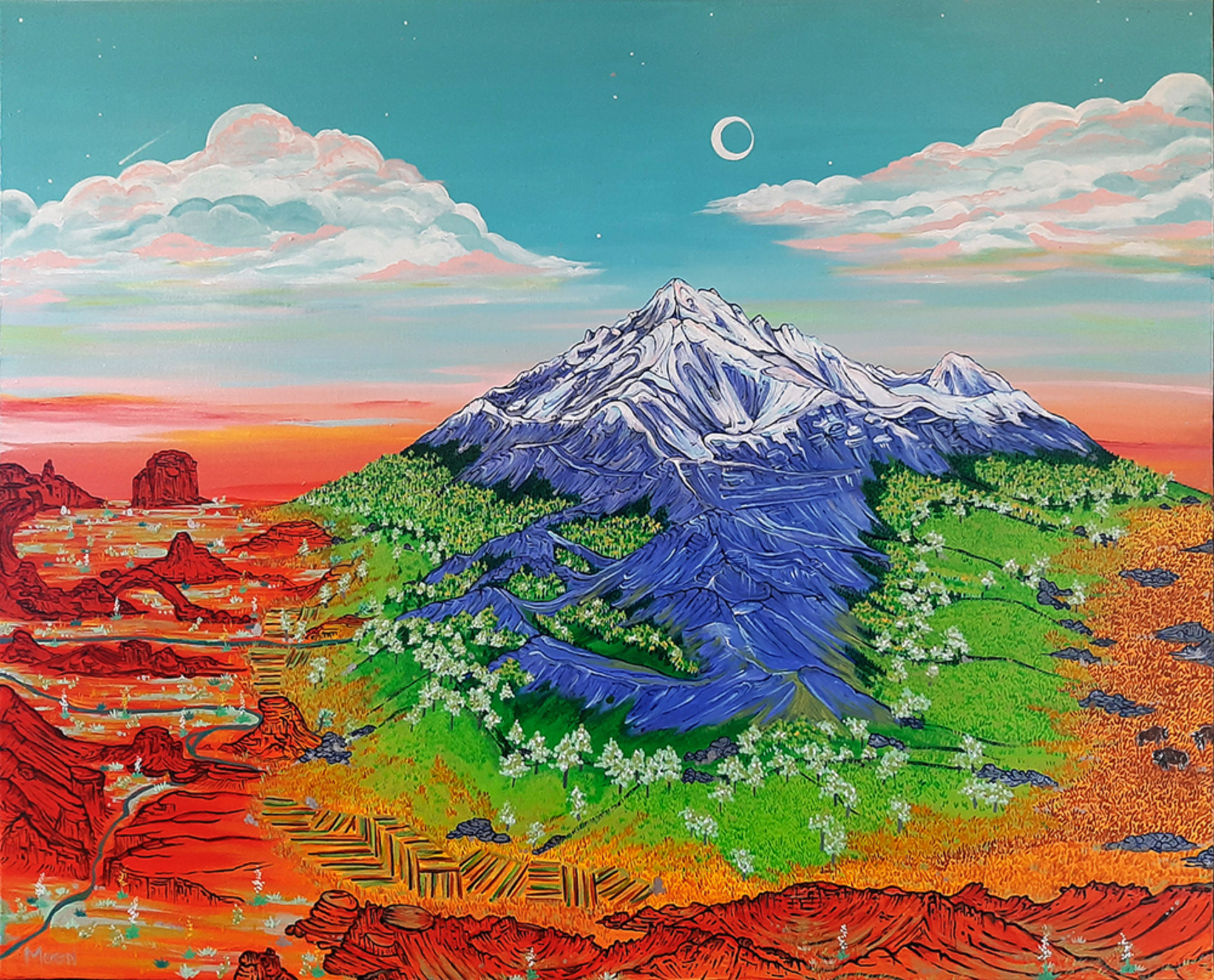

There are consistent patterns that can be found again and again amongst those who walk a spiritual path.
I am most knowledgeable about the patterns found in Buddhist practice, but I believe that these patterns can be ascribed to many walks of life (not just the spiritual ones). Human brains love to create patterns (it’s perhaps the thing that human brains are best at). It thus seems inevitable that throughout the centuries, while the Buddhist monks and nuns sat and meditated, with nothing to observe but the mind, they proffered many lists, diagrams, and maps of the brain and how it impacts one’s life. The ancient Buddhists were, to me, undoubtedly early psychologists. As I’ve touched on in previous posts, as someone who has dabbled in both Buddhism and therapy, it is a rather common occurrence that I encounter a “new” psychological model that is actually echoing quite keenly the insights of the early Buddhists.
However, their study of the brain was not clinical, nor was it in any way secular. The purpose of their study was entirely situated in faith. The Buddhists were not deists (at least, not most of them). They did not have faith in a God. They had faith in themselves and in the teachings of the Buddha that dictated that every person is capable of their own release from suffering. For a quick lesson in foundational Buddhism for anyone who is unfamiliar: The first teaching of the Buddha after his enlightenment under the Bodhi tree was the Four Noble Truths. These are the foundation for Buddhist faith. Every other insight and practice stems from these Four Truths. They also established the tradition of Buddhists clearly lineating their teachings into numbered lists.
The Four Noble Truths are:
- There is suffering. Every living being will experience suffering in their lifetime. It is inescapable.
- There is a cause of the suffering. That cause is the delusion of separation, from which stems the other two poisons in the world–greed and hatred.
- The cessation of suffering is possible. It is important to note that “suffering” is different from “pain”. Pain will always remain an inescapable part of life. The suffering comes from the mind–it is up to you how to process your pain so that you do not suffer.
- The cessation of suffering is accomplished by following the Eightfold Path (another numbered list within THE initial numbered list. As you can see, this is from the getgo a staple of Buddhism).
The Eightfold Path is a guide towards living an ethical life. It is, in true Buddhist nature, entirely subjective and interpretable. In order to escape suffering by walking this path, it is a requirement for one to look inwards and become self-aware and mindful. This is not a simple set of rules one must follow. It requires attention, adaptability, and grace. The Eightfold Path is as follows:
- Right View
- Right Intention
- Right Speech
- Right Action
- Right Livelihood
- Right Effort
- Right Mindfulness
- Right Meditation
I was taught that to live “right” according to the Eightfold Path is to live upright. It is to live in accordance with ethics, especially those taught by the Buddha based in ultimate Compassion and Wisdom.
These first teachings of the Buddha set the stage for what would become a largely peaceful religion throughout history (with some notable exceptions, there always are). I am trained as a Zen practitioner, which is a form of Mahayana Buddhism. Mahayana Buddhists refer to this early Buddhism, and these first teachings of the Buddha, as the “First Turning of the Wheel”. The Wheel is a common symbol used in Buddhism. It is most often seen, in fact, as a representation of the Eightfold Path. The “wheel” is representative of the Buddha’s teachings, called the Dharma. The practitioners of the First Turning (of which there are still many in the world) are called “Theravadans”.
The focus of the Theravadans’ practice is to reach enlightenment via the path that the Buddha laid out after his own awakening. An enlightened person, one who has reached such a level of understanding that they are released from their karma–and thus suffering–is called an “Arhat”. Enlightenment means achieving the ultimate understanding of reality–through this one can escape the cycle of birth and rebirth (and thus suffering) into nirvana (or to be “blown out”–as a match or a candle is).
As a quick side-note: Just as Christianity has its roots in Judaism because Christ was raised as a Jew in Palestine, Buddhism has its roots in Hinduism because The Buddha was raised as a Vedic practitioner in India. The idea of reincarnation thus does exist in Buddhism, but it doesn’t always have the same literal meaning as it does in Hinduism (the Tibetans are a notable exception to this). I was taught while at Zen center that reincarnation was more of a transfer of energy, and less of a soul hopping bodies. This is much more copacetic with my metaphysical understanding (based in science) of how death and life works.
The Mahayana Buddhists are practitioners of the “Second Turning of the Wheel”, brought to us by Nagarjuna, another Indian monk who lived about 500 years after the death of the Buddha. Mahayana Buddhism is identified by two primary facets:
1. As opposed to the Theravadans, who practice to achieve self-enlightenment and become Arhats, the Mahayanans practice for the enlightenment of all beings, and in doing so become Bodhisattvas; and
2. There is deep study and faith in the teachings of Nagarjuna–that of Emptiness.
Emptiness is a tricky concept and one that requires, in my experience and opinion, a lot of practice and study to understand. I will do my best to give a Cliff Notes version–so do not expect comprehensiveness.
Just as much of Buddhism is an ancient form of psychology, it is also an early form of quantum physics. Emptiness is the understanding that nothing inherently exists. This is of course, confusing on the mundane, macrocosmic, everyday level. Of course things exist. There are tables, cars, cups, dogs, trees, etc. We can look around and see them. Yet, if we look deeper, we see that they actually do not exist. Well before Niels Bohr proffered his model of the atom, the Buddhists had some sort of understanding that nothing is as simple as it appears. If we look closely enough, at the micro level, we can see that actually–that tree does not exist. It is mostly just a collection of hydrogen, carbon, and oxygen molecules. Indeed, even if we look close enough at the molecules and atoms that make up the tree, we see that they are actually mostly just empty space. Therefore, the tree is mostly nothing.
Or, perhaps, we could look at how that tree is not composed of matter, but of relationships–something far less tangible. It is not a tree, but the result in this moment of many things relating to each other. The water it absorbs into its roots becomes its sap. That water came from the clouds, which came from the sea, which used to run through a power plant, which used to run through a bathroom sink, which used to be in a glacier. The carbon dioxide it pulls from the air becomes its fuel. That carbon was buried under the ground for millions of years before it was pulled up and burned in a coal power plant. Thus it becomes that the carbon that once comprised the body of a Stegosaurus is now in the maple syrup produced by that tree, which in turn becomes a part of your body once you eat it on pancakes. There is no point in which the tree begins and the rest of the world ends. Everything in the universe is conspiring to come together in this one fraction of space-time to create that tree–or that mug, or that dog, or you. (This, of course, is an ancient understanding of ecology).
We perhaps won’t even touch on the very concept of “tree” and how it is contrived throughout the centuries, as all language is, to mean what it means to us today. If you look up the etymology for the word “tree” (as I just did), it is quite confusing. It has layers upon layers of meaning from all over the world that fold upon each other to give us today the concept of the word “tree”. Realizing something apart from our name for it is very difficult to do. There was one day while I was at Tassajara, washing my clothes, and I looked at a tree and realized in a flash that it was not a tree. It existed outside of the word “tree”. It only lasted a minute. Just as the human brain loves patterns, it also loves to name things. I actually am quite fond of our innate tendency to give potency to names. There are lots of powerful stories and mythologies about how true magic is knowing the actual name of a thing– tapping into the power of the name beyond the name.
The reality that there is a tree, and at the same time, that there definitely is not a tree can be explained by Nagarjuna’s teaching of the Two Truths. This is one of the most beautiful of the Buddhist paradoxes (of which Zen specializes). The first of the two truths is the Subjective Truth (the light), and that is the understanding that there is a universe and things in that universe that we can experience, know, and name. Ethics lies in the realm of the Subjective Truth.
The second truth is the Ultimate Truth (the dark), and that is beyond human comprehension in its grandeur and vastness. For example, I will never know all of the colors, as I am limited by the number of cones and rods in my eyes. I will never know what the vacuum of space feels like, nor what it could be to live without language. I am limited by all that comes together in my human life that has shaped my mind to think in the way that it does. Yet these things exist, whether or not I can experience and name them (or even know of them).
One of the reasons it’s so important to read about different perspectives, or travel and meet people who have different perspectives, is that it literally broadens your understanding of what is possible. It helps you step outside of the confines of your life as you know it so that you may expand. It helps to bridge the Two Truths, as does deep spiritual practice.
Studying the Two Truths is lovely because it allows oneself to accept the reality that two things that seem opposite are actually not opposite at all, but the same. The reality that something both does and doesn’t exist allows for far more possibilities in any given moment. It gets right to the heart of the delusion of separation. We suffer because we do not realize we are all the same. We are all the universe coalescing in a single moment to create everything as it is–before it all returns to the infinite once more. Therefore there is no need to be greedy or hateful. To love yourself is to love everything, and to love everything is to love yourself.
It is my belief that what Buddhists call the Ultimate Truth–this vast reality beyond our knowing in which nothing really exists, cannot be named, and is beyond sensing–is what many mystics throughout the ages have experienced as God. When I read the mystical poets of Islam, Christianity, Hinduism, or Judaism relating their experience of God, I see them making an amenable, heartfelt, beautiful attempt to name the unknowable. In these mystical accounts of their meeting with God, I feel their descriptions greatly match the accounts of Mahayana Buddhists achieving enlightenment. For this is a great teaching in the Second Turning–if one can truly know emptiness, to experience it rather than just intellectually understand it, then one becomes enlightened. It is through studying emptiness that I transformed from a hesitant Atheist practicing Buddhism into a mystic myself. This was my backdoor into God.
Now, here’s the rub–it is very common for those who study emptiness to become nihilists. This is a phenomenon that is, of course, catalogued and codified by the Buddhists. It is a common enough step on the spiritual path that is described in several places, including the Ten Oxherding Pictures and Dongshan’s Five Ranks. At some point in one’s spiritual journey, after realizing the emptiness of all things, one begins to ask oneself: ok, then what is the point? If none of this actually exists, then why live an ethical life?
This question may resonate with some readers who are not themselves Mahayana monks. It is a question that is asked throughout time, in different modes, through different lenses, with different backgrounds, beliefs, and upbringings: “To be or not to be?” Questioning the point of it all in the face of emptiness can only be compounded when considering the pains of the world.
During my second year of living at Green Gulch Farm Zen Center, I myself fell into a well of depression and nihilism. In the midst of studying the emptiness teachings I was hit by a piece of news about climate change. Upsetting news around the climate crisis has been a near constant companion of us all for the last couple of decades. It’s always distressing–and yet, sometimes, a piece hits harder than the others. Perhaps one just reaches a point of saturation with bad news where we just can’t take any more in and there needs to be overflow. This particular bit of news was about how the permafrost in the arctic is thawing. The permafrost has many ecological benefits in the arctic region. One incidental way it has been helping us out is by providing frozen caps over large bubbles of methane trapped right under the surface. As the permafrost melts, the methane is released. This is a large amount of methane (which is a potent greenhouse gas). The hotter it gets, the more methane is released, making it hotter still.
It is one of many positive feedback loops that will continue to make our planet increasingly inhospitable the warmer it gets. It is something that feels, frankly, hopeless. Facing this alongside the existential reality of the emptiness of all things, I frequently found myself numbly walking through my days (those who had never lived as a monk may be surprised by how many monks–people who have supposedly dedicated their lives to mindfulness–numbly go through their days), asking myself again and again–what was the point of it all? If me trying my best, living my best ethical life, wasn’t going to stop that permafrost from melting, wasn’t going to stop the widespread, cataclysmic change in climate, wasn’t going to stop the subsequent suffering of beings–what was the point of doing it at all?
It is around this time that I began to study the precepts. The precepts are vows to live one’s life as a Bodhisattva. This is a big deal in the life of a monk. I was only a lay monk, and was only going to be taking the precepts as a lay person. The precepts I took are the same precepts that a priest takes, but with a different intention. They were vows I was going to take for my own spiritual purposes. The precepts became my bouys–bits of shining light I could swim to and refuges for me to hang onto–while I weathered the dark waves of that nihilistic storm.
It is around this time that I also began to study Joseph Campbell, and found great meaning in the idea of The Hero’s Journey. I’d say that the Hero’s Journey also became, for me, a near religious force. I was–and am–very struck by the idea that throughout time and cultures, there is a pattern (humans love their patterns) of a person undergoing a transformation from the mundane to the heroic that can be found again and again, across mythologies. As Campbell lays out The Hero’s Journey, with its twelve discernible steps, it is noticeably similar to one of the many lists that the Buddhists make. It is a path towards understanding, towards something better, towards release.
I plan on doing a whole other post on the precepts (and the Hero’s Journey), so I won’t go into their details too much right now. I’ll just say that it became clear to me that taking the precepts was a very important step in my own hero’s journey. They are promises to live an ethical life, and to do so with the intent of saving all beings. I needed this guidance. I needed a clear ethical framework that I could come back to, again and again. I needed my buoys, steadfast and shining, in the tumultuous stormy sea of life. As is the Zen Buddhist way, the precepts are interpretable, vague, and seemingly impossible. Yet it is in their impossibility that they become inspirational. I found great courage in the fact that for hundreds of years people have been taking the precepts, dedicating their life to the saving of all beings, and doing it not because it is achievable, but because it must be done. It is the right thing to do.
The Buddha’s teachings are so transformative and important because they are wisdom and compassion paired. It would be one thing if the only truths he offered were that there was suffering and a cause of suffering. That is wisdom, certainly, and an important thing for everybody to accept at a base level. But he then continued on to give hope and direction in the face of that suffering. He offered compassion. Importantly, the root of that compassion is ethics. To live an ethical life, full of introspection and awareness–that is how one not only alleviates the suffering within their own life, but can alleviate the suffering of others as well.
The essence of the emptiness teachings is encapsulated by the Prajna Paramita. The Prajna Paramita is a recounting by Avalokitesvara–the Bodhisattva of Compassion–of the nature of all things to Shariputra, a disciple of the Buddha’s. It is called the Heart Sutra. A lot of new practitioners (myself included) are confused by this name. It is not one that necessarily inspires a lot of heart. Certainly not when compared to, perhaps, The Loving Kindness Meditation. However, it is not named The Heart Sutra due to any sort of loving feeling it inspires (at least, not necessarily). It is named the Heart Sutra because it gets to the heart of the matter. It is the core of the Mahayana teachings–it explains, in some great detail, the emptiness of all things. In the manner of the Buddha, this wisdom on the emptiness of all things is delivered by the being of ultimate compassion, Avalokitesvara. It is in this way that we know that this wisdom cannot be separated from compassion.
The Heart Sutra is as follows:
Avalokiteshvara Bodhisattva, when deeply practicing prajña paramita, clearly saw that all five aggregates are empty and thus relieved all suffering. “Shariputra, form does not differ from emptiness, emptiness does not differ from form. Form itself is emptiness, emptiness itself form. Sensations, perceptions, formations, and consciousness are also like this. Shariputra, all dharmas are marked by emptiness; they neither arise nor cease, are neither defiled nor pure, neither increase nor decrease. Therefore, given emptiness, there is no form, no sensation, no perception, no formation, no consciousness; no eyes, no ears, no nose, no tongue, no body, no mind; no sight, no sound, no smell, no taste, no touch, no object of mind; no realm of sight … no realm of mind consciousness. There is neither ignorance nor extinction of ignorance…neither old age and death, nor extinction of old age and death; no suffering, no cause, no cessation, no path; no knowledge and no attainment. With nothing to attain, a bodhisattva relies on prajña paramita, and thus the mind is without hindrance. Without hindrance, there is no fear. Far beyond all inverted views, one realizes nirvana. All buddhas of past, present, and future rely on prajña paramita and thereby attain unsurpassed, complete, perfect enlightenment. Therefore, know the prajña paramita as the great miraculous mantra, the great bright mantra, the supreme mantra, the incomparable mantra, which removes all suffering and is true, not false. Therefore we proclaim the prajña paramita mantra, the mantra that says: “Gate Gate Paragate Parasamgate Bodhi Svaha.”
If all perceptions, sensations, and experiences are only the result of an ineffably wondrous and grand universe coming together as it does, then there is permission to let go. To let go of the ego, let go of desire, let go of hate, let go of greed. There is only space, and that space is filled with compassion.
And yet–in all of this we must also remember that there is not only space, but real people and real consequences for our actions. We need to uphold the reality of the Two Truths. We are a part of the universe coming together as it does in every moment. A balance, a middle way, needs to be practiced here. It is a duty of our human life to strive towards the perfection of the Ultimate Truth while walking–as best we can–perfectly in the imperfection of the tangible reality. One cannot abide forever on the mountaintop, coasting off of the grand knowledge of emptiness. One needs to go down to help others out of the mud–and maybe splash around in it a little bit too, while we’re down there.
To abide in the reality that all is empty without compassion is a dangerous and unhelpful way to be. It encourages spiritual bypassing, which is utilizing wisdom without compassion. It is not meeting and overcoming suffering through compassion, understanding, and love, but instead stepping around and over the suffering (or, bypassing it, if you will). I’ve known many, many people who are very practiced spiritual bypassers. I am sure I have done it myself. It is an easy trap to fall into as a spiritual practitioner–to believe that because you have had some small enlightenment yourself, you no longer need to do any dirty work. But, of course, there is no lotus without the dirty water.
I’m offering and musing on all of this today because it is helpful to hold on to the idea that there is a grand purpose to one’s life, and that there is something important that is worth striving for. To rest in the emptiness (especially the nihilism of emptiness) is to shun a great gift and shirk great potential. What the world needs now is people who think about the Great Matter, and give it meaning through their actions and beliefs.
Yes, it all feels impossible right now. There is so much suffering. The climate crisis only grows more dire. The epitome of greed is causing catastrophic devastation across families, communities, nations, and the world; There are several widespread man-made famines, as well as a genocide, being perpetrated by men who do not strive for the mountaintop in any sense. There are many people in power right now who do not dwell on the intrinsic necessity for compassion, nor the very actual reality of interconnectedness. This is manifest greed and hatred resulting from very tangible delusion. It is causing catastrophic harm to people and the environment.
In order to meet this great suffering and to find meaning for one’s life amidst it all, it is important to spend time thinking about ethics. How do you live your life for the sake of others? Hopefully, thinking about this will inspire action, conviction, and consideration for how one can live a life of purpose. I only hope that there is more of that in this world. There is a great needs more buoys of light as our world churns about in its own grand, dark storm. People choosing to live an ethical life–not because it will work, but because it is necessary–is something that the world is thirsty for. I need to remind myself of this, as I do of many things, often.
If you live your life for the sake of goodness, it is worthwhile. Keep going.
Gate Gate Paragate Parasamgate Bodhi Svaha (Gone, gone, gone to the other shore, awakening, amen).
Reading now: Stamped from the Beginning by Ibram X. Kendi , The Well of Ascension by my boi Brandon Sanderson, and We Are Three by Rumi (translated by Coleman Barks)
Listening now: I’ve been enjoying this song. It feels pertinent to today’s post: Mantras by Ellen Winter.
First there is a tree
Then there is no tree
Then there is.