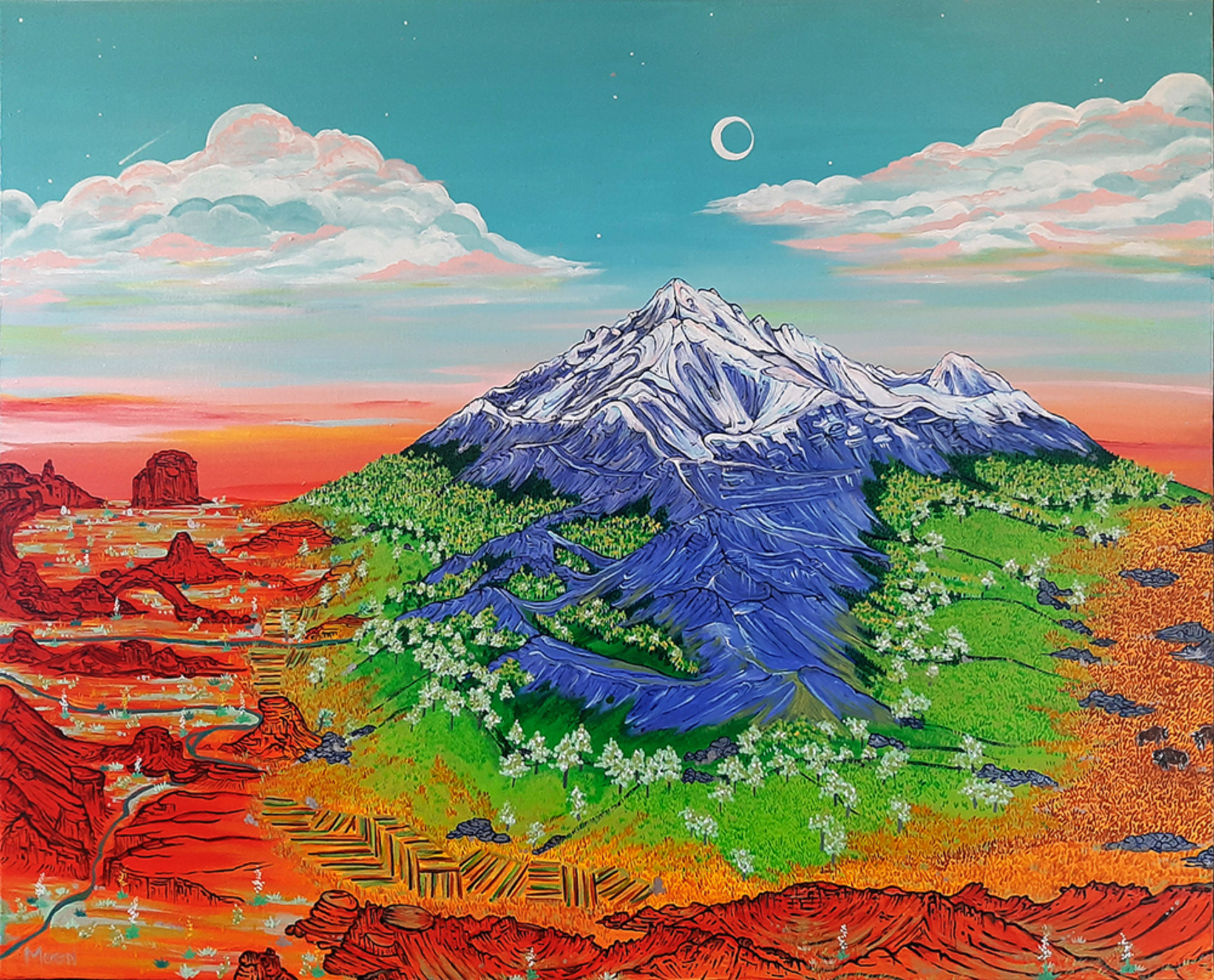

I had a dream last night that was lovely. I had been recruited by some friends (not friends from real life, unfortunately–but rather a group of comedians that I have been watching online a lot lately, that in my dream were my friends) to live with them on a communal farm homestead.
In the dream there was a large, cozy farm house where everyone had their own room. There was an impressive kitchen and chore charts to keep track of how everyone who lived and farmed there could contribute to their communal living space. There was also a matriarch–the owner of the land who had collected all of these young people together to live on her farm, in her home–to build this vision of community together. She was a round, rosie, cozy woman, with a kind voice and a tough, earthy body that comes from a lifetime of tending the ground.
In the dream I immediately knew that I wanted to join this community, and looking around, noticed a niche that was not filled that I could take on with joy. I pitched my idea to the matriarch–that in exchange for a room in this farmhouse and space in this community, I could help take care of the farmers and the home. I could cook meals for them, clean the house, tend to the kitchen garden–and when extra hands were needed, I could pitch in and help in the fields.
She immediately took my idea seriously, and included other members of the community in on the conversation, in a genial, inclusive way. The idea was workshopped by herself, myself, and the others in the room until my space in the community felt beneficial to all. Not once did I feel fear of rejection. I knew as soon as she started discussing with me the details of my stay that I was accepted.
I woke up from the dream immediately feeling wistful of that place I had just been. Being on that farm, in that community, was soothing in me a deep longing for a connection to the land and to other people that I have been feeling quite keenly lately. The dream was undoubtedly inspired by the media I have been consuming lately, which only after having this dream did I realize has all been largely centering on this idea of living in community, in connection with the land.
As I mentioned before, I’ve been watching this group of comedians online a lot. I’ve got a roster of such groups that I like to watch. I find it incredibly soothing to watch a group of funny people–who are all clearly friends who love and respect each other–spend time together, playing games and making each other laugh. I am not alone in this, as such groups are highly popular all over the internet, and I think their popularity was only springboarded during the pandemic, when people were especially thirsty for connection. It is entirely parasocial and scratches some itch–although entirely superficially–of belonging to a group. All this while distracting you from the horrors of the world through whimsy and cleverness. Some of my favorites come from Dropout, Smosh, and Polygon (although less so this one recently). The Smosh crew is who lived with me on the farm in the dream.
I’ve also been playing a lot of Stardew Valley–a game I knew that I would love that was gifted to me last Christmas by my sister-in-law. For those unfamiliar, Stardew Valley is a slow, cozy game where you inherit a farm from your grandfather in a small, rural village. The game entirely consists of creating and running your farm, forming relationships with the village folk, doing community service projects (often rather whimsical ones), fishing, and if you’re feeling adventurous, doing some mining (where you can even fight off monsters, what a thrill). The entire game sells the idea of living a small, quiet, rural life quite effectively.
Finally, I happen to be reading two books, both of which depict an ideal relationship between humanity and the land, albeit in completely different ways. A Psalm for the Wild-Built, by Becky Chambers, is a short, charming fiction book set in an idyllic moon far away–but clearly inspired by our home here. This story follows a gender-queer monk as they navigate their need for purpose in an utopian world. This world is one built after a sudden awakening of robots shook people from their reliance on technology and their rapacious speed towards progress and production. The robots were not violent upon their awakening, but instead politely curious–choosing to forgo living in human society to experience the natural world. In the wake of this event, the people themselves heightened nature to a sacred place–dictating that half of the world be left completely wild, and those spaces where humanity still abides be lived in concert with nature. The protagonist is a tea monk–or someone who travels from rural town to rural town with a tea cart which they set up with the sole intention of being a sanctuary for people. It is a lush, vibrant, kind world that the reader (I believe any reader, not just myself) yearns for while reading.
The other book that I’m reading now is called Braiding Sweetgrass by Robin Wall Kimmerer. This is a non-fiction book that portrays how life has been and can be a balance between humanity and the natural world. Kimmerer herself is a member of the Potawatomi tribe (a tribe native to Wisconsin, which adds to the potency of this book for me personally), a botanist, professor, and environmentalist. In the book she beautifully, sweetly, and honestly connects her indigenous, somatic, personal knowledge of plants with her more Western-trained, scholarly, academic knowledge of them to really drive home the ancient and still necessary relationship between humankind and our natural world. The book is filled with heartwarming anecdotes from her own life of how she formed her own relationship to plants and the natural world, such as picking strawberries as a child, boiling maple syrup with her own children as an adult, and of course, the sacred act of harvesting and braiding sweetgrass. I am listening to it as an audio book in which Kimmerer herself is the narrator, and you can hear the care she has for what she writes about so earnestly in her voice.
I believe that the matriarch from my dream was inspired by a combination of Kimmerer and a woman, an icon, and an idol that I know from my real life, Wendy Johnson. I met Wendy while living my few years in community on farmland at Green Gulch Farm, where I formed my own deep connection to the land and to the plants there. Wendy was one of the original members of the community that helped build up the farms and gardens when San Francisco Zen Center first bought the land for Green Gulch Farm in the 80s. She is a woman who captivates anyone within minutes of meeting her–she speaks much as Kimmerer does, as someone who has spent a lifetime in relation with the world. While speaking she would lace together incredibly potent images of the connectedness with all things, drop into Shakespeare quotes with ease in such a way where it took a minute to realize that is what she had just done, and sprinkle in enough of the serious and dark to know that her wisdom is born from not only of love, but also suffering. Everyone adored Wendy, and Wendy adored everything. She saw the importance, instantly, of whatever–or whoever–was in front of her.
It is at Green Gulch, under the tutelage of Wendy and other caring monks, that I first learned what it meant to be in relationship with plants. My job as a gardener entailed caring for many perennial trees, shrubs, and flowers–as well as of course shepherding annuals through their seasons. I only tended the garden for just shy of 2.5 years, and in that time I already could tell the impact of what true, concentrated care could have on the well-being of plants. How one prunes fruit trees or roses impacts their growth for years to come. How one tends to the health of the soil is how one tends to the health of all future plants grown there. How one deals with potential pests–whether that be coddling moth larva that chew through the apples and roses, or raccoons that would always ravage the apples and pears before they were ripe enough for anyone else to get a chance at them–indicated how happy everything else was in that space, including the beneficial animals and plants. To care for the garden was to operate with close observation, careful trial and error, shared knowledge from gardener to gardener, the heartfelt cultivation of rich compost, and patience.
I was especially fond of the many roses we had in the garden. I believe that in truly tending to a rose, you can see its personality. Each rose variety is different, and has different needs, different wants, different circumstances for thriving. Some roses require actual blood and bone (meal) to thrive. Some cannot abide being near others, while others crave it. Some only blossom through a thorough and steady pruning, while others require a more delicate and precise cut.
I came to sanctify the thorns of the roses. It took only a few months before I stopped gardening with gloves, because I loved always feeling the dirt with my hands. It took only a few more months for me to stop wearing gloves while pruning the roses. It felt like a fair exchange–that while I worked removing some of their limbs (as necessary as that removal might have been for their health), they took some of my blood in exchange through their many scratches along my hands and arms.
I came to love that garden like I would a person, with all of her facets and complexity, all of her desires and fears, all of the ways in which she needed attention, and some other areas in which she was best left alone to her own wisdom of selfcare. It taught me that the world was alive, and to care for it was not only a necessity for a fulfilling life, but a great honor. This feeling of love has carried forth to every other garden I have cared for since, whether they be small garden boxes at home or school gardens. The importance of love and relationship to the land was something I hoped to instill, even just in spirit, with the hundreds of students I had the honor of teaching in gardens. It feels increasingly urgent and necessary to me that children learn to love their world, and to form relationship to it.
I woke up this morning knowing that my dream was not only inspired by the media I had recently been consuming, but from my own inherent longing to feel connected to community and land again. This is something I have been dwelling on since our big recent trip back to the United States. I believe that listening to Braiding Sweetgrass for a little bit before we left planted the seed of this idea, and it was only given more ground as we returned to the U.S. As I listen to Kimmerer tell her stories filled with indigenous wisdom about the land, it strikes me how she is talking clearly about America–or, Turtle Island. Her mythology, her knowledge, her relationship, is with the trees, berries, grasses, and animals of my home.
Indeed, something I’ve been thinking a lot about since moving to Germany is just how splendid the landscape, the natural world, of the United States truly is. It is a vast landscape filled with every sort of environment. Gratitude is owed to the naturalists of the late 19th/early 20th centuries who moved to preserve the natural beauty of the United States so that we could still know and encounter it today. Of course, I am of the camp that believes that if the indigenous folks were left to be stewards of that land (instead of, you know, being miserably, violently, morbidly displaced by White colonizers,) there would be vastly more natural beauty left to behold. Even considering that, there is no denying the potency that still remains in the land across America. The great Rocky Mountains, the lush forests of the Pacific Northwest, the colorful, rugged deserts of the South West, the Redwood trees and rocky cliffs of the California coast, the sweeping loneliness of the American plains, even the vivacious Southern swamps and bayous–there is a lot of splendor that America offers.
My DNA is largely composed of Irish, Scottish, and German ancestry. I had always wanted to travel to these places in Europe to see if I could feel connected to the land in any sort of deep way, stemming from my blood. I have now had the privilege of visiting Ireland and living in Germany (and a trip to Scotland is upcoming in November). Indeed, I believe I am even living in the part of Germany where most of my German ancestors would have harkened from (they were, I believe, Prussian, and thus from Northeast Germany, where I now am–Dad you can correct me on this). I will say that traveling to Ireland felt more like a soul connection than I’ve yet to find in Germany. I keep hoping I will find it here. Perhaps it is just that Ireland is largely still very cozy, whereas East Germany has been very modernized (at least the parts I’ve largely been in, definitely so Greifswald).
I do not believe I have any American indigenous ancestry–I think I once heard that on my dad’s side there may have been one indigenous ancestor–but I do not know a lot about this, and they would just be a drop of red in an ocean of white. Nevertheless, there is undoubtedly more of a soul connection that I feel with just about any part of America than I do out here. This is, perhaps, largely unsurprising. As despite my ancestry not being native to America, my body is. That is where I was born and shaped. That is the land that fed me, body, mind, and soul. That is the land where I learned to love nature, and the expanse of the world. I am entirely sculpted by scrambles along steep, rugged high alpine rocks or along dry, red, smooth and scratchy rocks stretching underneath an interminable desert sky. My oceans are the Atlantic, where I would spend my childhoods on the quaint and busy beaches of Cape Cod, and the Pacific, where I would spend nights gazing out over the crashing waves as an adult. The greatest love of my life was significantly shaped by hours and hours of driving together through those vast lonely plains traversing from Wisconsin to Colorado and back, watching storms dominate the sky across the endless fields of corn and soy beans–imagining them filled instead with buffalo.
Of course, the United States is especially home because of the people there. The beautiful tapestry of people that make up the United States. The complex community of wave after wave of immigrants, all having to undergo their own hardships in pursuit of a better life. A life that is promised to all, but accessible to few. American cities are glorious in that you can travel block to block and experience many different cultures, communities, families, and traditions, all within a short walk. You can find dim sum, tacos, health food smoothies, injera, tikka masala, french pastries–all within one afternoon of ambling around. You can hear music from all over the world, see people of all sorts falling in love, children of any various ancestral backgrounds playing together in a park.
It is where my family and friends are, for the most part. The United States is my home. It is the land and the community that I belong to, composed of the tapestry of all of the lands and communities I have belonged to. As I wrote in my post from early July (Am I Proud to Be an American?)–I am proud to be from America. I am not proud of America.
For all that exists there, all that makes it diverse, interesting, and naturally beautiful, there seems to be a dark force working to unmake all of that in the names of greed and fear. So many protected lands are being opened up to exploitation by the oil, gas, and lumber industries under our current administration. The natural world to this administration is nothing more than something that can be sterilized and turned into a commodity–or perhaps a luxury golf course. Almost every diverse natural biome in the U.S. has been under threat for decades, and whatever progress that has been made to protect what’s left seems to be constantly being undermined by the wealthy few, for whom enough is never enough.
As for the diversity of people–that is perhaps even more acutely under attack. People of color live in fear in an increasing number of cities because there is a government police force moving with absolute authority, fully masked, unbadged, and unwarranted–rounding up anyone who looks different from them with impunity–or anyone that stands in their way of doing so. Citizens are not safe. Skilled, highly-desired, legal immigrants are not safe. People who are just here trying to make their lives better, as was promised to them on the Statue of Liberty, are not safe. The poor, huddled, tired masses, yearning to be free are increasingly living under threats of unlawful and immoral kidnapping, deportation, and imprisonment.
The very concept of “legal” vs “illegal” immigration is, historically, one that is entirely based on racist prejudice. On our recent trip to the U.S. we spent a few hours at a natural history and cultural museum on campus at the University of Oregon. There we learned all about the history of Chinese migrants in the U.S., and the hardships they endured. It was as a racist response to Chinese immigrants that the first acts determining which immigrants were “illegal” were passed, greatly restricting the rights of Chinese people in America. Before these acts (all in the late 1800s), there had been no such designation as an “illegal immigrant” in the United States. Since then, the U.S. government has shifted several times to designate different groups large-scale as “illegal”, based on the racist and/or xenophobic opinion of the day: The Irish, The Japanese, people from Muslim countries, people from Latin America, etc. Learning the history of the United States, you end up learning more and more about how much racism is an integral part of the laws and government. It is wild to live somewhere that has never not spouted the ideals of “freedom and liberty for all” while simultaneously actively working to undercut the rights and safety for many people.
Michael and I very much wish to return to the U.S. once his contract is fulfilled here. Again, our recent trip back only highlighted for us how much the U.S. really is our home. We’re constantly back and forth between thoughts of returning to Colorado or returning to Madison, two places that for us are undeniably home. However, we are also trying to start a family. It is not just our futures and our sense of home that we must consider.
We know that one can live as an American citizen, and through information and compassion, come to know the reality of our history, and thus seek to do better than those of the past (or, today). We would teach our kids the importance of knowing all elements of history, even the difficult ones, so that they learn what not to do as we all work in an effort to build a kinder world. We will teach them about the land–the plants, the animals, the rocks, the dirt, the flowers, the bugs–so that they will know it is all something they exist in relationship with, not something they live over. We will teach them about the importance of being curious about anything or anyone that is seemingly different from themselves, how to interact with that difference in kindness, and how to be respectful of everybody and everything. There is a desire to build a future that will make our home better, and closer to the ideals that it has promised for centuries–but never quite lived up to.
However, there are practical matters that we can’t help but consider, along with the idealistic ones. It is highly, highly likely that Michael and I will have white, blue-eyed, blond-haired children. As such they, like us, will be born into a place of privilege, either in the U.S., or here in Germany. Thus, if we return to the U.S., it is highly unlikely that our family will be directly impacted by ICE cruelty, or that we would suffer an infringement on any of our rights. However, it does seem likely that they could live in a world where their classmates’ or friends’ families are torn apart by ICE. Or that they could experience a school shooting, as nothing has been done at all to curtail those horrific incidents. Or that they could go to school and be subject to a curriculum that teaches them nothing at all about people or cultures other than the homogenous white narrative, and does not encourage critical thinking of that narrative. It could be that they never experience the joy of the outdoors in quite the same way that we did while growing up, due to extreme weather phenomena resulting from climate change.
It is also stark to think about the comfort of our lives as a family in the U.S. versus the abundance of support we’d receive as a family here in Germany. Here we have free healthcare, free child care, extensive family leave, six weeks of paid vacation, and a truly affordable college education (it’s like 200 Euro a semester, probably less). Not to mention that it’s actually affordable to live here–a 3 bedroom house (fancy standards in these parts) would cost us less than 250,000 Euro. Food is still entirely reasonably priced. Furthermore, Germany takes green energy more seriously, and so there is more of an ethos around environmental care. There is, of course, also no school or mass shootings.
Compare this to what we know waits us back in the U.S.: expensive and unreliable healthcare, expensive child care, virtually no family leave, maybe a few weeks of vacation, astronomical college tuitions, insanely expensive housing, and expensive food. Comparing these practical matters, it seems like the most logical choice for us would be to stay in Germany. Our lives, monetarily speaking, would undoubtedly be much more comfortable here. And yet—it is not our home. It is not our land, it is not our community. It is hard for us to imagine raising our family so far from our hearts.
We are both experienced enough with moving and traveling around to know that this is undoubtedly homesickness. However, there are definitely places where upon moving there I never experienced homesickness because it so undoubtedly and immediately felt like home. Green Gulch was such a place for me, as was Madison. This was not a feeling I immediately felt with Greifswald–or even at large, Germany or Europe. I do not wish to sound ungrateful. There are many things for which I am grateful for living here. It is undoubtedly a unique experience, getting to live in a foreign country, to necessarily need to learn another language and become adjusted to different customs and a different way of life. It is already a perspective I cherish–because being an immigrant (even a wanted one that can blend in, physically at least, to the community I moved to) is a difficult experience.
For those who know me well, or who have read other blog posts in which I’ve talked about this, moving here was not an easy choice for me. I was very, very resistant to it. A primary reason for this is that I know that I am someone who thrives when I have a deep connection to where I’m living. When I live in relationship to the community and land. I had that in Madison. I was teaching children to garden. I was helping to raise a lovely little boy as his nanny. I was close to the community of the city’s land stewards. Furthermore, Madison really is suffused with natural beauty. The naturalist culture thrived there and preserved a lot of land to be enjoyed for generations to come. I felt close to my purpose there. I am at a time in my life where I crave setting down roots, establishing a home, caring for land that is mine to care for for decades. Living on land and in a community that my children can cultivate, and that in turn cultivates them.
I think if I were to ultimately have one life goal–it would be aging into someone like Robin Wall Kimmerer or Wendy Johnson. To be a woman whose spirit has been weathered to gentleness and whose body has been kept sturdy by how closely I lived to the ground. I want to be someone who inspires those of the next generation to live in relationship to their land, and to each other. Someone who can acknowledge the deep suffering and cruelty of the world, and yet who knows the remedy. Someone who, in fact, can offer that remedy by taking some kids berry picking or providing a spot of solace in the soundbath of trees quaking in the wind. Someone who builds refuge with their bare hands, who then can offer it to those in need with an open, genuine heart. I hope to be the matriarch from my dream that can so readily offer community to those with genuine interest in joining.
That is the goal. The reality now is that I am in Greifswald, Germany, living four stories up in a soviet-built concrete block apartment building. I am separated by most people around me by a language barrier. I don’t live much in relation to the land. But I can spend my time reading, writing, and creating. I can take as much time and space as I need to take care of myself, and our life here. This is what is.
Given that, I now am tasked with asking myself questions around my circumstances and my desires. How do I cultivate my heart image, my (literal) dream of living in graceful responsibility towards others and the land? Can the ever-present companion of anxiety allow me to venture forth and seek that here? Is this time meant for cultivating something else that will ultimately serve that goal, that dream, down the line? Of course, the ever-present Zen question: By focusing on what is not, am I ignoring what is?
Perhaps the answer to all of these questions lies, as most things do, in one of my favorite Zen axioms: Not knowing is most intimate.
Perhaps to hold true to the beacon of my heart-dream along with the present intimacy of not knowing is all there is to do right now.